
See what your process is really doing. Before you scale it.
When you’re developing a new material, process, or application, guesswork is expensive.
A Complete Solid-State Microwave Lab System Built for Real Insight
Fully integrated solid-state microwave system that brings precision, flexibility, and control to R&D, testing and small batch precision heating and drying applications.
Every component is designed to work together so the data you generate is meaningful, repeatable, and transferable allowing you to experiment and innovate with solid-state RF microwave energy in a way that is scalable to real-world applications.

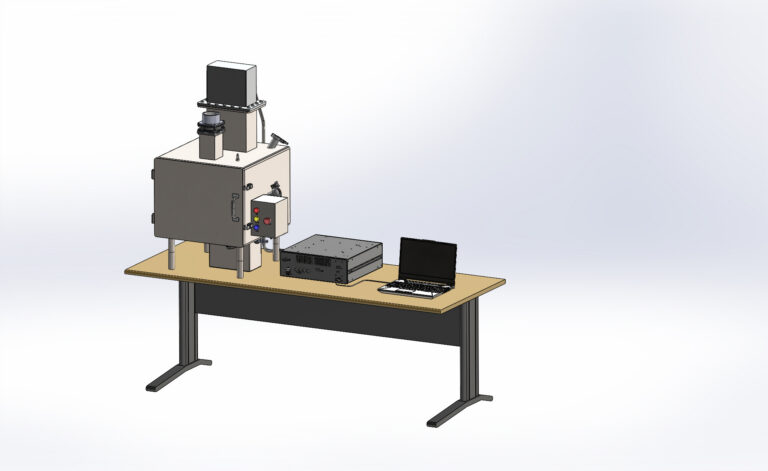
Integrated solid-state microwave system
2.5kW solid-state microwave generator with patented PrecisePower™ software and LabWave test chamber.

Frequency-agile, precise power control
Tunable across the 902-928 MHz band to explore material behavior at various frequencies with accuracy and repeatability.

Adaptive power control
Automatic power control to adjust changing operating conditions
Solid-state reliability
No magnetrons, no tubes to fail. Extended lifetime with minimal maintenance.
Test, innovate, and scale with confidence.
The LabWave Test System gives you real, measurable insight into how materials interact with microwave energy— so you can test, innovate, and scale with confidence. All in a controlled environment. All in your own lab.
System Components:
- LabWave Test Chamber
- PTL-2.5kW Microwave Generator
- PrecisePower™ Software
- WR975 Waveguide with 716 DIN Adapter
- Optional Accessories:
- Turntable kit, Pressurization kit, IR Pyrometers, Thermal Imager, Video Camera, Very High Temp kit
Designed for versatility. Built for performance.
The LabWave Test Chamber gives process engineers and researchers the versatility, precision and repeatability needed for innovation, helping you discover breakthroughs.
The chamber’s geometry is optimized for volumetric heating, supporting scalable experimentation. Whether you’re characterizing novel materials, validating process parameters, or simulating industrial RF heating, this solid-state platform accelerates innovation with performance that mirrors production-scale systems —right from the lab bench.
High Temperature Capacity
Ideal for heat-treating specialty metals, materials science, and manufacturing R&D in a controlled lab setting.
Integrated Accessory Ports
6 tri-clamp ports for sensors and other instrumentation provide real-time monitoring of temperature, pressure and more.
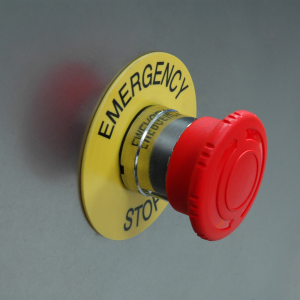
Built-in Safety Features
E-stop push button and contacting door switch provide enhanced safety with near instantaneous shutdown if an unsafe condition occurs.

Inert Gas Atmosphere Control
Controlled, oxygen-free environments, prevents oxidation and contamination during process. Ideal for high-value materials, metal powders and reactive compounds
Validated Across Industries Where Accuracy Isn't Optional
Built on the same solid-state RF platform trusted across industrial, research, and pilot-scale environments, LabWave is for teams who need defensible data, repeatable outcomes, and confidence that lab results will hold up in the real world.
From discovering new commercial materials or processes to academic research, the LabWave Test System supports innovation where precision and insight matter most.




Key Capabilities of the LabWave Microwave Test System
- Software-Driven Operation
Intuitive software control supports rapid configuration changes, automated frequency sweeps, and repeatable test conditions—reducing setup time while increasing experimental confidence and data quality. - Industrial-Grade Solid-State Architecture
Designed for reliability, long service life, and scalability. The PTL-2.5 provides a stable development platform that supports transition from laboratory research to higher-power, production-scale systems.
Accelerate R&D With 915 MHz Solid-State
Most laboratory microwave testing has been performed at 2450 MHz, not because it’s ideal. But, because it’s the old way it has been done.
The problem? At higher frequencies, microwave energy interacts primarily at the surface of a material. That limits penetration depth, restricts sample size, and often produces results that don’t reflect what’s actually happening inside the material—or what will happen at scale.
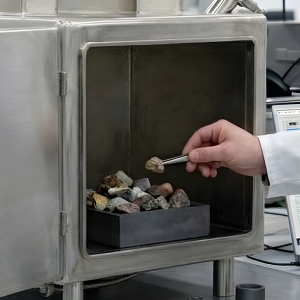
LabWave is designed around solid-state power at 902–928 MHz for a reason:
Lower frequency delivers deeper penetration, more uniform energy distribution, and data you can trust when scaled beyond the lab.

Deeper microwave penetration for truer insight
At 902–928 MHz, microwave energy penetrates 2–3× deeper into materials—often 9 inches or more, compared to just 1-2 inches at higher frequencies. This enables testing of thicker, denser, and more representative samples.
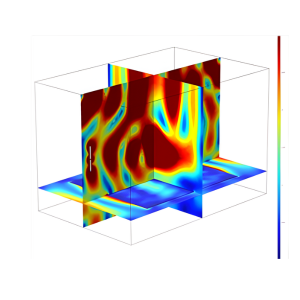
More uniform microwave heating throughout the material
Lower frequency results in reduced field attenuation, allowing energy to interact more consistently across the sample—not just at the surface.
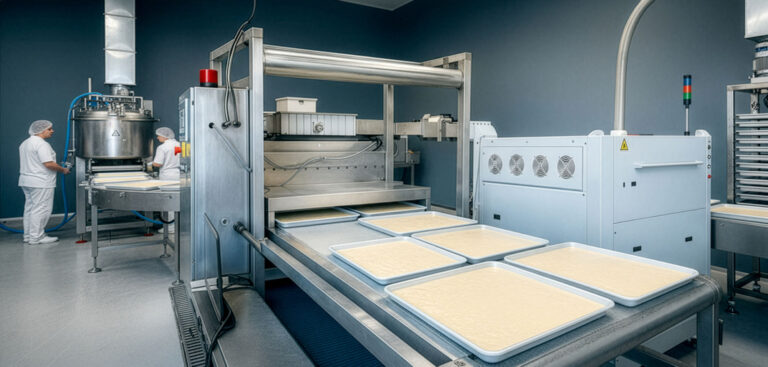
Data that reflects real material processing conditions
Testing at 915 MHz produces results that more closely resemble pilot and production-scale systems, reducing surprises during scale-up.
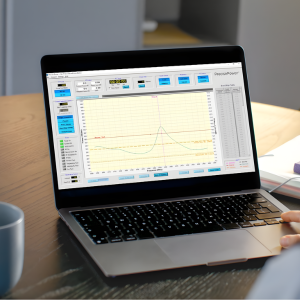
Continuously variable, software-driven control
Solid-state power enables smooth, precise adjustment of power and frequency—without the fixed-step limitations common in legacy lab systems.
Consistency from lab to scale
By aligning lab testing frequency with industrial solid-state implementations, LabWave helps bridge the gap between experimentation and deployment—turning experiments into repeatable, scalable outcomes.
Better frequency choices lead to better decisions— before scale, before capital, before commitment.
Frequently Asked Questions
How is LabWave different from traditional lab microwave systems?
Unlike conventional magnetron-based lab microwaves, LabWave uses solid-state RF technology, providing precise frequency control, repeatable power delivery, and real-time measurement of forward and reflected power. This results in better data, higher repeatability, and test conditions that closely mirror industrial-scale systems.
Can LabWave support scale-up to production systems?
Yes — this is one of LabWave’s core advantages. LabWave is designed to replicate the behavior of Crescend’s industrial solid-state microwave systems, allowing insights gained in the lab to translate more reliably to pilot and full-scale production environments.
What types of materials and applications can be tested?
LabWave supports a wide range of applications, including: advanced materials and ceramics, minerals and ores, biomass and waste-derived materials, chemical processing and drying, specialty metals and composites, microwave assisted chemistry and more.
Its volumetric heating design enables experimentation across diverse material types and thermal requirements.
Contact us to talk to an engineer about your specific material and process.
What accessories are available for LabWave?
We recommend a range of accessories that have proven compatibility with the LabWave, including temperature monitoring, gas handling, sample fixtures, and ports for custom instrumentation. Accessories can be configured based on your specific testing goals and material requirements.
Is training or application support available?
Absolutely. Crescend works alongside your team with application guidance, engineering support, and optional on-site commissioning to accelerate results. From early-stage lab testing through production-scale system design, we help ensure your microwave process is built for success.
Is there a device or methodology to identify preferential heating points (“hot spots”) within the cavity?
A thermal camera typically does the best job of identifying hot spots within a sample. For a purely electromagnetic hot spot, an antenna or coaxial probe would need to be installed to measure the electric field strength at that point, but this wouldn’t provide a comprehensive map of nodes & antinodes in the cavity.
How can oxidization be prevented using this chamber?
A thermal camera typically does the best job of identifying hot spots within a sample. For a purely electromagnetic hot spot, an antenna or coaxial probe would need to be installed to measure the electric field strength at that point, but this wouldn’t provide a comprehensive map of nodes & antinodes in the cavity.
How does the LabWave chamber handle chemical reactions where gases are generated? Can gases be extracted from inside the chamber?
Removing off-gassing during a test can be managed through the ceiling exhaust port. Also included is a 4” diameter tube adapter. The test cavity features an exhaust design that can handle off-gassing and includes an exhaust fan and filter. The exhaust port is a 4” diameter tube adapter that can be connected to flexible hose with a hose clamp. The filter & fan assembly is installed at the cavity port and can be removed and replaced with a downstream vacuum pump to pull off-gassing out of the cavity. A condenser or cold trap can be added in-line to recollect the gas. For this use-case, we recommend purchasing an optional waveguide gas barrier to prevent any off-gassing from reaching the waveguide interior.
What type of gas outlet connection is typically used?
The exhaust port is a 4” diameter tube adapter that can be connected to flexible hose with a hose clamp.
What type of cooling system does the PTL2.5 microwave generator use?
The primary cooling system is water cooling. The power supply is air cooled.
Do your systems include automatic detection and shutdown for electrical arcing (discharge)?
No, but you can integrate an arc sensor into the LabWave. We have an Arc Detector input connection on all generators that is designed to very quickly shut down the generator when an arc occurs.
What safety systems are incorporated (e.g., microwave leakage detection, pressure control, gas management)?
The system has been designed to minimize microwave leakage and has been testing for quality. We have tested the Labwave system and it meets all OSHA regulations for microwave leakage limits. Safety interlocks for the door are standard to prevent any accidental operation of the microwave generator while the door is open; pressure relief valve is available to prevent over-pressurization during inert gas purges. Inert gas flow and pressure are handled by the user, the LabWave unit does not have any native control over this. Optional sensors are necessary to measure precise oxygen levels.
There are no incorporated detection devices pre-installed. We recommend clients purchase microwave leak detectors (Radman or others) to confirm a safe operating environment.
How is LabWave different from traditional lab microwave systems?
Unlike conventional magnetron-based lab microwaves, LabWave uses solid-state RF technology, providing precise frequency control, repeatable power delivery, and real-time measurement of forward and reflected power. This results in better data, higher repeatability, and test conditions that closely mirror industrial-scale systems.
Can LabWave support scale-up to production systems?
Yes — this is one of LabWave’s core advantages. LabWave is designed to replicate the behavior of Crescend’s industrial solid-state microwave systems, allowing insights gained in the lab to translate more reliably to pilot and full-scale production environments.
What types of materials and applications can be tested?
LabWave supports a wide range of applications, including: advanced materials and ceramics, minerals and ores, biomass and waste-derived materials, chemical processing and drying, specialty metals and composites, microwave assisted chemistry and more.
Its volumetric heating design enables experimentation across diverse material types and thermal requirements.
Contact us to talk to an engineer about your specific material and process.
What accessories are available for LabWave?
We recommend a range of accessories that have proven compatibility with the LabWave, including temperature monitoring, gas handling, sample fixtures, and ports for custom instrumentation. Accessories can be configured based on your specific testing goals and material requirements.
Is training or application support available?
Absolutely. Crescend works alongside your team with application guidance, engineering support, and optional on-site commissioning to accelerate results. From early-stage lab testing through production-scale system design, we help ensure your microwave process is built for success.
Is there a device or methodology to identify preferential heating points (“hot spots”) within the cavity?
A thermal camera typically does the best job of identifying hot spots within a sample. For a purely electromagnetic hot spot, an antenna or coaxial probe would need to be installed to measure the electric field strength at that point, but this wouldn’t provide a comprehensive map of nodes & antinodes in the cavity.
How can oxidization be prevented using this chamber?
A thermal camera typically does the best job of identifying hot spots within a sample. For a purely electromagnetic hot spot, an antenna or coaxial probe would need to be installed to measure the electric field strength at that point, but this wouldn’t provide a comprehensive map of nodes & antinodes in the cavity.
How does the LabWave chamber handle chemical reactions where gases are generated? Can gases be extracted from inside the chamber?
Removing off-gassing during a test can be managed through the ceiling exhaust port. Also included is a 4” diameter tube adapter. The test cavity features an exhaust design that can handle off-gassing and includes an exhaust fan and filter. The exhaust port is a 4” diameter tube adapter that can be connected to flexible hose with a hose clamp. The filter & fan assembly is installed at the cavity port and can be removed and replaced with a downstream vacuum pump to pull off-gassing out of the cavity. A condenser or cold trap can be added in-line to recollect the gas. For this use-case, we recommend purchasing an optional waveguide gas barrier to prevent any off-gassing from reaching the waveguide interior.
What type of gas outlet connection is typically used?
The exhaust port is a 4” diameter tube adapter that can be connected to flexible hose with a hose clamp.
What type of cooling system does the PTL2.5 microwave generator use?
The primary cooling system is water cooling. The power supply is air cooled.
Do your systems include automatic detection and shutdown for electrical arcing (discharge)?
No, but you can integrate an arc sensor into the LabWave. We have an Arc Detector input connection on all generators that is designed to very quickly shut down the generator when an arc occurs.
What safety systems are incorporated (e.g., microwave leakage detection, pressure control, gas management)?
The system has been designed to minimize microwave leakage and has been testing for quality. We have tested the Labwave system and it meets all OSHA regulations for microwave leakage limits. Safety interlocks for the door are standard to prevent any accidental operation of the microwave generator while the door is open; pressure relief valve is available to prevent over-pressurization during inert gas purges. Inert gas flow and pressure are handled by the user, the LabWave unit does not have any native control over this. Optional sensors are necessary to measure precise oxygen levels.
There are no incorporated detection devices pre-installed. We recommend clients purchase microwave leak detectors (Radman or others) to confirm a safe operating environment.